Holographic Relativity III — the Rule Space
oxexp-rule-space · the 256 agreementsThe story, in three renders — read first, then verify
Every image here is a readout, not an illustration: each pixel is a bit of the
actual evolution, rendered straight from the engine by bin/ooi-render-rule-space.py
(stdlib PNG writer over the frozen substrate — regenerating reproduces the bytes exactly).
Each render carries one measured claim, and the instrument panels below verify that claim
live on this node — the narrative first, the evidence one scroll away. Click any render
for the full-resolution PNG.
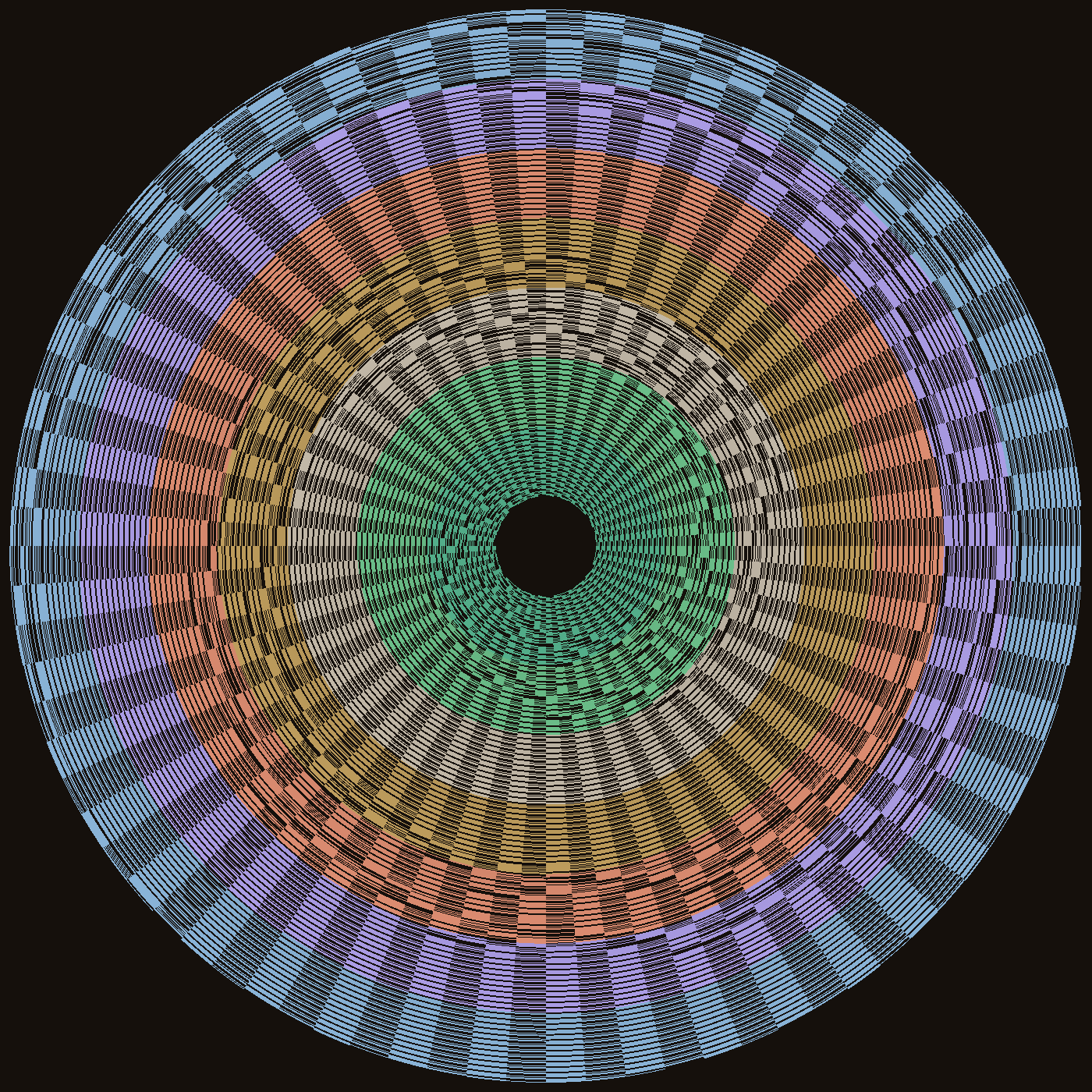
I · The seven arms. Rule 110 settles after τ = 498 into
a 630-tick orbit. Angle is the 84-ring, radius is time, one hue per 90-tick layer. The
measured symmetry row(t+90) = rot(row(t), 60) makes each layer the layer beneath it
rotated 60 cells, and the ring closure 84/gcd(60,84) = 7 closes the orbit:
630 = 90 × 7. The “random-looking” class-IV orbit is a layered
rotation — the disc is the closure made visible, seven layers screwed around the ring in
sevenths. verify: the ether clock ↓
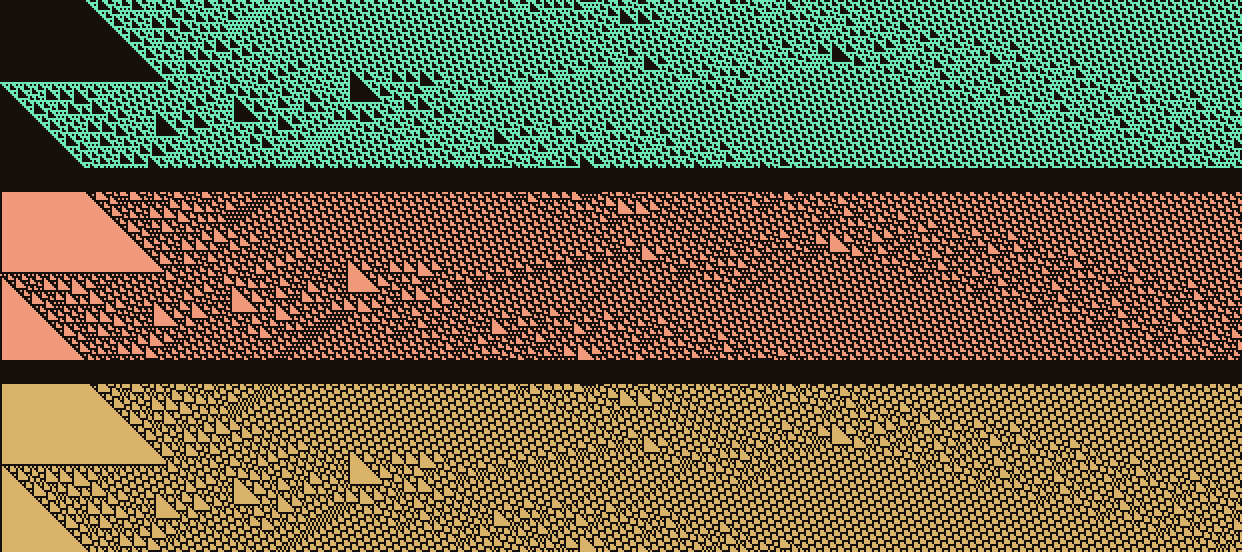
II · The diode. Swap figure and ground in rule 110's truth
table and you get rule 137 — complement(110) = 137. Same single seed, same
ring, time flowing left→right: 110 (teal), 137 (coral), their XOR (gold). The conjugacy
run(137, ~s) = ~run(110, s) checks bit-exact, and the differential settles at density
4/7 — the complement of 110's measured change rate s̄ = 3/7:
figure and ground partition the sevenths (3/7 + 4/7 = 1), the same sevenths as the orbit
closure. verify: the diode panel ↓
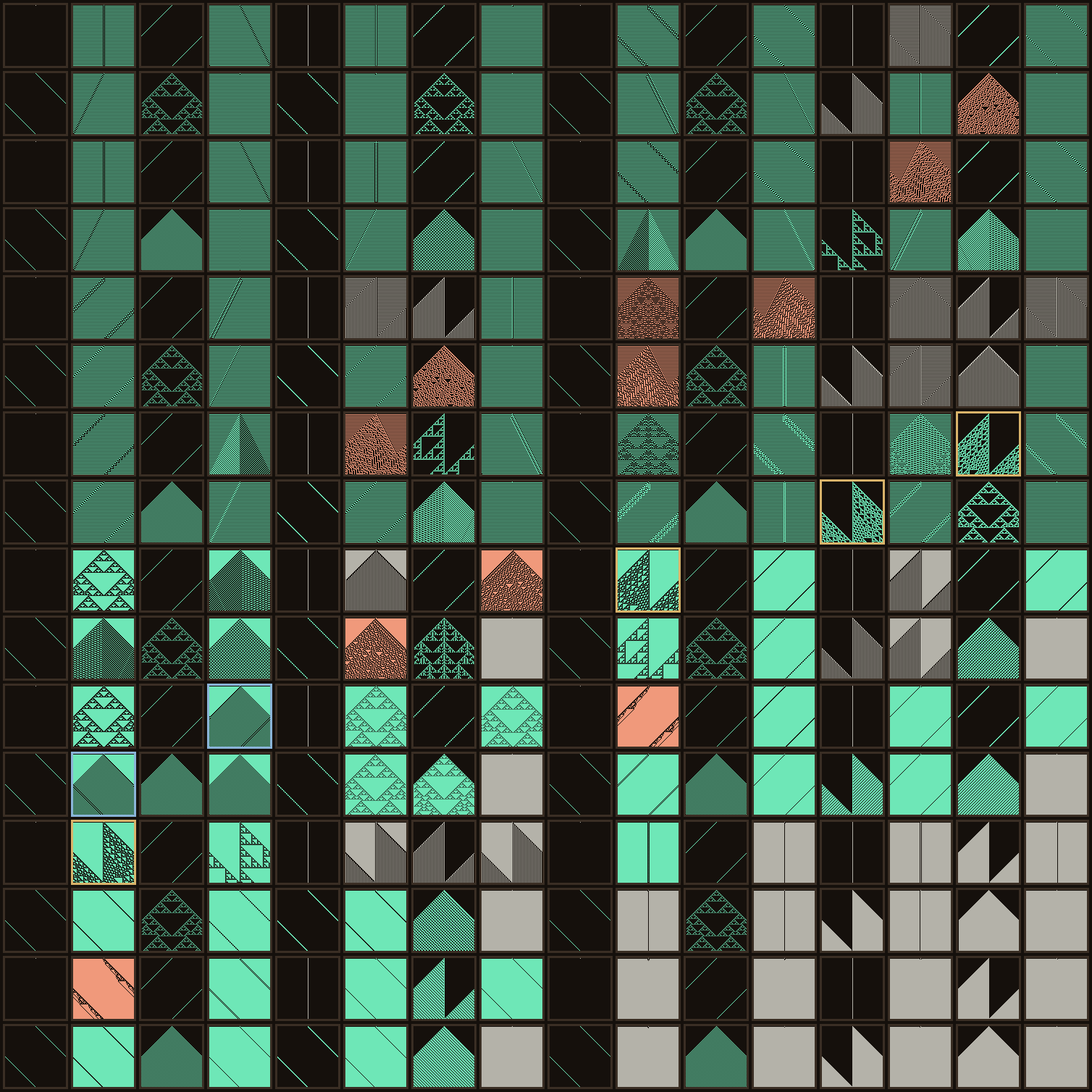
III · The atlas of 256. Every rule, row-major from 0, the first 84 ticks from the single seed; tint is the measured reading at budget 4096 — teal = settled orbit, grey = frozen, coral = foam (unsettled). Gold frames: {110, 124, 137, 193} — one rule up to mirror and complement, and the top of the measured capacity band; blue frames: {163, 177}, the only other members of the E-band [0.17, 0.25]. Only six rules of 256 migrate class as the window grows — exactly the class-IV set. verify: the spectrum ↓ · the migration census ↓ · the E-band ↓
The spacetime strip — one agreement, caused
A neighborhood (l, c, r) is a triadic read (past-present, self,
emerging-present); a rule is a synthetic agreement — a fixed answer to "what is effectual
next?" — and 2⁸ = 256 is the epoch-0 window. The world is the 84-cycle
cage of I/II (the 4×21 NodeMatrix as the ring; the stride-5 aperture tinted); the seed is
the bifurcation '1' (State 0 → (0,0,1)). Every run is one caused, deterministic
evaluation. Rule 110's mirror family is {110, 124, 137, 193} — the complement of 110 is
137: the fundamental through the 0,1 diode.
The spectrum — the capacity band over all 256 (H1)
C = settled · rel · log₂(period) — the channel form: 0 at
frozen (period 1 — the indifference edge), 0 at foam (unsettled within the budget), finite
between. H1: Wolfram's classes are the capacity band. Measured at first light (2¹²):
the top of the band is the 110 family — {110, 124, 137, 193} all at C = 9.2943, period 630;
the XOR skeleton (90/150/…) next at ~7.98 (period 252 = 3×84); rule 184's period = 84
(one revolution); rule 30 = foam; s̄(110) = 3/7 exactly (the sevenths).
The window relativity (H7) — the class is a reading at a window
The same rule read at a ladder of budgets. Measured: rule 110 is foam at ≤ 2¹⁰ (unsettled, C = 0) and the band peak at ≥ 2¹¹ (τ = 498, period = 630 — its ring horizon is 1128). Wolfram's classification is window-relative: a rule migrates class as the observer's budget scales — the relativity this series is named for.
The diode — figure against ground (Phase B: H4 + H8)
Two observers from the same bifurcation seed: A = the rule; B = a mirror-group partner
— complement = the diode (137 = 110 through the 0,1 exchange), mirror,
mc, delta = the in-plane co-operable (the same rule, +δ ticks), or an explicit rule = a
true externality. The conjugacy run(c(R), ~s) = ~run(R, s) is verified
bit-exactly. Measured: the 110⊗137 differential settles at the same horizon (τ 498, p 630)
with gap = 4/7 — the complement of s̄ = 3/7: figure and ground partition the
sevenths (3/7 + 4/7 = 1). H8 (directional verifiability, the MI asymmetry of the aperture
streams): mirror ≈ symmetric (+0.007, the co-operable); mc strongly one-way
(−0.61 — the one-way operable dynamic); the diode mild (−0.10); the in-plane shift =
the forward arrow (+0.20); foam/frozen = no channel (MI ≈ 0).
The 88 true units — the mirror-group census (Phase B)
The 256 agreements fall into 88 equivalence classes under {id, mirror, complement, mirror∘complement} — the xor-mirror resolution of rule space. Capacity coherence within a class is measured, not assumed (the single-'1' seed is mirror-symmetric but not complement-symmetric). Measured @ 2¹²: 71/88 coherent; 17 split under figure/ground exchange — while the 110 family stays coherent at the band peak.
The deep battery (Phase C) — the ether clock · the perimeter law · the migration census
The ether clock (H3): the settled orbit's exact layered symmetry — for 110,
row(t+90) = rot(row(t), 60) exactly, and the sevenths enter as the ring closure
84/gcd(60,84) = 7: 630 = 90 × 7, so the capacity decomposes as
log₂(630) = log₂(90) + log₂(7) (cell 70% / closure 30%). The glider
drift alphabet measures in thirds: {+1/3, 0, −2/3} (relative speeds include exactly 1).
Contrast: rule 90 = 126×2; rule 184 = 1×84 — pure ring closure.
The perimeter law (H5): the space-elongated shapes hit the wall (6×4, 8×3, 8×2
blind — the directional confinement reproduced; 2×12 the max), the linear correlation is
partial (r 0.56); foam is gated by settledness (rule 30: 0/8 admissible). The migration census
(H7): across 2⁸..2¹³ only 6 of 256 rules migrate — exactly the class-IV set:
the 110 family {110, 124, 137, 193} + {109, 182}. Window-relativity is a Class-IV signature.
The E-band & the impedance (Phase D) — H6 + the artifact
The running E per rule: E* = τ/w* — the unverified fraction of the
marginal window (the first budget of the dyadic ladder at which the rule settles).
Measured (H6): the E-band [0.17, 0.25] census contains exactly six rules —
the 110 family {110, 124, 137, 193} at E* = 0.2432 ≈ ¼ (2.7% off the surprise
quantum — the cost of existence) + the {163, 177} pair; the settled median residual is
0.0039 (~60× lower); foam E* = 1 by failure-to-settle. Computation lives where the
marginal residual matches the conjecture's externality budget. The impedance
Z = horizon/capacity (GROW ticks per OPERATE bit): the 110 family pays ≈ 121
vs the band median ≈ 13 (~9×); the cheapest agreement is rule 1 (Z = 2). The 4/3
plane ratio does not appear in these measurables (reported, held). The publish button
exports the 256-rule dataset to CKAN (live when configured, else the dummy node).
The trust-ladder ensemble (Phase E) — the accounting engine as a population
Three 0.75-plane automata (rule 110) on the synchronized beat (3 ticks own-work + 1 ingress = the 0.75 : 0.25 split — the beat model implements the plane arithmetic; the measured content is the knowledge/GROW trade). Each runs the accounting engine per peer: predict from the account → observe → reconcile (miss → write-back; failed FDV → E-mark). The defector publishes a rule-51 mask (the consistent liar — a constant word) over an honest 110 run. Measured: H12 — blind aggregate 2.25 · verify 1.5 (v=1) / 1.125 (v=2 — the collapse toward ≤1) · believe ≈ 2.23. H11 — know converges to 0.043 (the curve reaches 0) vs perceive stuck at 0.645: the write-back is knowledge. H10 — blind faith learns the lie fluently (false-knowledge 0.973, never caught): total exposure when an unconfirmed source sits inside the perimeter. H9 — believing is the Pareto policy: catches the defector (E-marked, false-knowledge 0) at ≈ 99% of blind throughput. A-retention — delegating the account to the defector fragments it (honest-pair error 0.991 vs A-local 0.023): exactly one A, kept local, measured as the guard.
The dataset
Every recorded sweep (oxexp-rule-space · local-first).
| seq | budget | seed | rules | settled | top | top C | 110 C | 30 C | 110 s̄ |
|---|